




When God Is Not Part of Your Plans
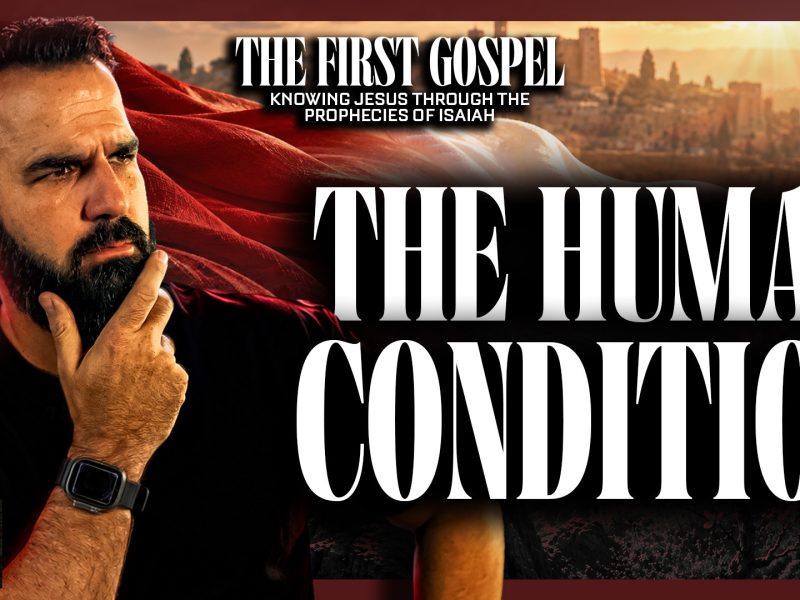
The First Gospel: Knowing Jesus Through the Prophecies of Isaiah — Episode 2
Isaiah 2:1–4:1
By nature, we want to be in control. We manage our calendars, finances, families, careers, and futures as though enough planning can guarantee the outcome.
But we are not in control.
That was one of Israel’s great mistakes in Isaiah’s day. The nation was experiencing prosperity, strength, and security. Their success created a false sense that they were untouchable. But beneath that prosperity were pride, misplaced trust, spiritual compromise, and a growing confidence in everything except God.
In Isaiah 2:1–4:1, the prophet shows us what happens when God is no longer at the center of our plans.
Isaiah’s message moves between extraordinary promise and sobering warning. We see the mountain of the Lord exalted, the nations coming to learn God’s ways, and God establishing His house. But we also see a society increasingly consumed by idols, materialism, pride, superficiality, and misplaced confidence.
And right in the middle of that judgment comes a word of hope:
God always has a faithful remnant.
Isaiah 2 and the “Latter Days”
Isaiah 2 begins with a remarkable vision:
“It shall come to pass in the latter days that the mountain of the house of the LORD shall be established as the highest of the mountains… and all the nations shall flow to it.”
— Isaiah 2:2
What are these “latter days”?
Pastor Tim explains his amillennial understanding of this passage: rather than viewing Isaiah 2 exclusively as a prophecy of a future literal thousand-year kingdom following Christ’s return, he understands Isaiah to be describing the age of Christ and His Church.
This is not presented as an issue over which Christians should divide. Believers who hold different views of the millennium can remain brothers and sisters in Christ.
The key connection in the study is Acts 2.
On the Day of Pentecost, people from nations across the known world were gathered in Jerusalem. The Holy Spirit was poured out, the apostles proclaimed the works of God, and Peter explained what was happening by quoting the prophet Joel:
“And in the last days it shall be, God declares, that I will pour out my Spirit on all flesh…”
— Acts 2:17
Isaiah speaks about the latter days. Peter speaks about the last days.
Hebrews makes a similar declaration:
“But in these last days he has spoken to us by his Son…”
— Hebrews 1:2
From this perspective, Isaiah was looking forward to the age inaugurated by Jesus Christ—the age in which the Gospel would go out from Jerusalem to the nations.
The Mountain of the Lord and the House of God
Isaiah says that the mountain of the house of the Lord will be lifted above the other mountains and that people from the nations will flow toward it.
This is prophetic imagery.
The physical Temple Mount is not literally the highest mountain in Israel. Pastor Tim explains that mountains in prophetic imagery can represent kingdoms, rulers, and powers.
Jesus is the King above every other king.
His Kingdom is above every earthly kingdom.
And upon Christ, God is building His house.
Peter describes believers this way:
“You yourselves like living stones are being built up as a spiritual house…”
— 1 Peter 2:5
The house Isaiah sees is ultimately fulfilled in the people of God built upon Jesus Christ.
Christ is the cornerstone.
The Church is His spiritual house.
And through the Gospel, people from the nations are being drawn to Him.
“Come, Let Us Walk in the Light of the LORD”
After describing this extraordinary future, Isaiah gives a simple invitation:
“O house of Jacob, come, let us walk in the light of the LORD.”
— Isaiah 2:5
This connects beautifully with the message of Isaiah 1.
God has already invited sinful people to come to Him:
“Though your sins are like scarlet, they shall be as white as snow.”
— Isaiah 1:18
First John uses remarkably similar imagery:
“But if we walk in the light, as he is in the light, we have fellowship with one another, and the blood of Jesus his Son cleanses us from all sin.”
— 1 John 1:7
God does not simply expose sin.
He cleanses sinners.
He calls them out of darkness and invites them to walk in His light.
But beginning in Isaiah 2:6, the tone changes dramatically. Isaiah turns his attention from those who repent to a culture that has forsaken God.
7 Signs of a Culture Under Judgment
Isaiah was speaking directly to Judah and Jerusalem in his own time. Yet the patterns he identifies raise important questions for every generation.
Pastor Tim highlights seven signs of a culture under judgment in Isaiah 2–3.
1. A Culture Under Judgment Imports Strange Spiritualities
Isaiah writes:
“For you have rejected your people, the house of Jacob, because they are full of things from the east and of fortune-tellers like the Philistines…”
— Isaiah 2:6
Israel was supposed to influence the surrounding nations with the truth of God.
Instead, Israel began adopting their spiritual practices.
Fortune-telling, sorcery, pagan practices, and foreign spiritual influences began replacing confidence in the Lord.
The warning is simple: when people abandon the true God, they do not stop worshiping. They simply find something else to worship.
2. A Culture Under Judgment Believes Its Military Is Its Security
Isaiah describes a nation filled with horses and chariots.
In the ancient world, these represented military power.
There is nothing wrong with a nation defending its people. The problem comes when military strength becomes the source of ultimate confidence.
Armies cannot replace God.
Weapons cannot replace God.
Political power cannot replace God.
Security becomes an idol when we begin trusting it to provide what only God can ultimately give.
3. A Culture Under Judgment Prioritizes Material Success
Israel possessed impressive things.
Isaiah mentions silver, gold, treasures, cedars, oaks, towers, fortified walls, ships, and beautiful craftsmanship.
Yet God warns that everything humanity exalts can be brought low.
“The haughtiness of man shall be humbled, and the lofty pride of men shall be brought low, and the LORD alone will be exalted in that day.”
— Isaiah 2:17
Material success can create the illusion of permanence.
But wealth disappears.
Buildings fall.
Businesses fail.
Technology becomes obsolete.
Human beings die.
That is why Isaiah eventually says:
“Stop regarding man in whose nostrils is breath, for of what account is he?”
— Isaiah 2:22
Anything built without God is ultimately insecure.
4. A Culture Under Judgment Selects Unserious Leaders
Isaiah 3 describes the removal of mature, capable leadership and its replacement with immaturity:
“And I will make boys their princes, and infants shall rule over them.”
— Isaiah 3:4
The picture is larger than the literal age of a leader.
It is a picture of immature leadership.
Wisdom disappears. Responsibility disappears. Serious leadership becomes difficult to find.
The result is instability throughout society.
5. A Culture Under Judgment Scorns Authority
Isaiah continues:
“The youth will be insolent to the elder, and the despised to the honorable.”
— Isaiah 3:5
The normal standards of honor become reversed.
Those who should be respected are despised. Those who lack maturity reject correction. Eventually, responsible people no longer even want to lead.
Pastor Tim connects this pattern with Paul’s warning in 2 Timothy 3, where the last days are characterized by people who are lovers of self and money, proud, arrogant, abusive, and disobedient to their parents.
When biblical authority is rejected, disorder follows.
6. A Culture Under Judgment Sidelines Men
Isaiah describes a society in which the structures of responsible leadership have broken down.
Pastor Tim uses this passage to discuss the biblical responsibility of men in the home and Church.
Biblical authority, however, is not domination.
It is responsibility.
A husband is called to love his wife. A father is responsible to care for, lead, protect, and provide for his family. Christian leadership is modeled after Christ, who exercises authority sacrificially rather than selfishly.
When men abandon that responsibility—or when a culture treats responsible male leadership as something inherently undesirable—the biblical order of the home and society is disrupted.
7. A Culture Under Judgment Becomes Consumed With Superficiality
Isaiah then turns to the women of Zion:
“The LORD said: Because the daughters of Zion are haughty and walk with outstretched necks, glancing wantonly with their eyes…”
— Isaiah 3:16
Isaiah describes a culture increasingly obsessed with outward presentation, sensuality, status, and appearance.
Pastor Tim connects this with Peter’s instruction to Christian women:
“Do not let your adorning be external… but let your adorning be the hidden person of the heart…”
— 1 Peter 3:3–4
The point is not that outward appearance is irrelevant.
The warning is against allowing external appearance to determine personal value.
God looks deeper.
Character matters.
Holiness matters.
The hidden person of the heart matters.
What Happens When God Is Removed?
Isaiah’s warnings can be summarized simply.
Without God, objects become idols.
The things we possess begin possessing us.
Without God, impressive structures become illusions.
We begin trusting what looks permanent but can disappear overnight.
Without God, society turns upside down.
Honor, authority, responsibility, and morality become confused.
Without God, what society builds will eventually be lost.
Every human kingdom eventually comes to an end.
That is why Isaiah’s message reaches beyond ancient Judah.
It confronts every nation—and every individual—with the same question:
What are you trusting instead of God?
God Always Has a Faithful Remnant
After this long description of judgment, Isaiah suddenly gives us hope:
“Tell the righteous that it shall be well with them, for they shall eat the fruit of their deeds.”
— Isaiah 3:10
Even when a culture turns away from God, God preserves a faithful remnant.
Pastor Tim traces this pattern throughout Scripture and Church history.
Noah remained faithful in a wicked generation.
The Hebrew midwives feared God under Pharaoh.
Joshua and Caleb believed God when the other spies did not.
Elijah thought he was alone, but God told him there were still thousands who had not bowed to Baal.
Daniel, Shadrach, Meshach, and Abednego remained faithful in Babylon.
Esther and Mordecai remained faithful in Persia.
And throughout Church history, believers have preserved and proclaimed biblical truth during seasons of extraordinary spiritual darkness.
The question is not simply whether the surrounding culture will remain faithful.
The question is:
Will you?
Four Truths to Remember From Isaiah 2–4
1. God Has a House on His Mountain
Every human kingdom eventually falls.
God’s Kingdom does not.
His house is being built upon Jesus Christ, the cornerstone.
2. You Can Be Full of Everything and Still Be Empty Without God
Israel had prosperity.
Israel had military strength.
Israel had impressive accomplishments.
But prosperity without God produced pride rather than security.
You can possess everything the world tells you to pursue and still discover that none of it can satisfy the deepest needs of your soul.
3. Stop Regarding Man
Human beings cannot save us.
Leaders cannot save us.
Money cannot save us.
Institutions cannot save us.
Every human being has breath in his nostrils.
Our ultimate confidence must be in God.
4. The Day of the Lord Reverses What This World Values
Everything humanity exalts will ultimately be measured against the holiness and authority of God.
Pride will be humbled.
False security will be exposed.
Idols will fail.
And the Lord alone will be exalted.
How Isaiah 2–4 Points to Jesus
Isaiah does not ultimately leave us with judgment.
He points us toward Christ.
Jesus is the cornerstone of God’s house.
He is the foundation upon which the people of God are being built.
Jesus humbles the proud and draws the nations to Himself.
What Isaiah saw prophetically begins unfolding through Christ, Pentecost, the Church, and the worldwide proclamation of the Gospel.
Jesus is the foundation on which you can build a full life.
Everything else eventually gives way.
Christ does not.
That brings Isaiah’s message directly into our lives.
When God is not part of our plans, success can become pride, possessions can become idols, security can become an illusion, and human beings can become substitutes for God.
But when we turn to Christ, we discover a foundation that cannot be shaken.
Questions for Reflection
1. What are you elevating that belongs only to God?
Consider your ambition, reputation, security, relationships, success, or anything else that may be competing with God for first place in your life.
2. How does the mountain of the Lord in Isaiah 2:1–4 reframe the future God is building for you?
3. What would surrendering those sacred ambitions to God actually look like?
Frequently Asked Questions
What is Isaiah 2 about?
Isaiah 2 contrasts two realities: the future exaltation of the mountain and house of the Lord and the judgment of human pride, idolatry, materialism, and misplaced trust. It calls God’s people to “walk in the light of the LORD.”
What are the “latter days” in Isaiah 2:2?
In this study, Pastor Tim interprets the “latter days” as the age inaugurated by Jesus Christ and manifested through His Church. He connects Isaiah 2 with Acts 2 and Hebrews 1, both of which describe the period inaugurated by Christ as the “last days.”
What is the mountain of the Lord in Isaiah 2?
Pastor Tim understands the mountain prophetically as pointing to the Kingdom of God established through Jesus Christ, with God’s spiritual house—the Church—built upon Christ as its cornerstone.
How does Isaiah 2 connect to Acts 2?
Isaiah describes nations coming to Jerusalem to hear God’s Word. In Acts 2, people from nations throughout the known world gather in Jerusalem at Pentecost, hear the works of God proclaimed, and receive the Gospel. Pastor Tim presents Pentecost and the early Church as the fulfillment of the pattern Isaiah describes.
What does Isaiah say about a culture under judgment?
In Isaiah 2–3, Pastor Tim identifies seven patterns: adopting false spiritualities, trusting military strength, prioritizing material success, embracing immature leadership, scorning authority, sidelining responsible male leadership, and valuing superficial appearances over inward character.
What is the faithful remnant in the Bible?
The faithful remnant refers to those who continue trusting and obeying God even when the surrounding culture turns away from Him. Scripture repeatedly shows God preserving faithful people during periods of widespread rebellion and judgment.
How does Isaiah 2–4 point to Jesus?
Jesus is the cornerstone of God’s spiritual house, the King whose Kingdom stands above earthly kingdoms, and the One who draws people from the nations to Himself. He is the secure foundation upon which believers can build their lives.
Continue Your Study
Go deeper with The First Gospel: Knowing Jesus Through the Prophecies of Isaiah companion devotional and journal.
Designed to accompany this 40-episode journey through Isaiah, the journal gives you space to follow the teaching, record what you’re learning, answer the reflection questions, and apply God’s Word personally.
The purpose of Bible study isn’t simply to know more.
It’s to know Christ, grow in faith, and allow God’s Word to change us from the inside out.
Up Next
Continue with Episode 3 of The First Gospel: Knowing Jesus Through the Prophecies of Isaiah as Pastor Tim continues through the book of Isaiah and uncovers how its prophecies, warnings, promises, and pictures ultimately lead us to Jesus.
Join the Conversation & Stay Connected
Continue studying Scripture with Pastor Tim Hatch and Tim Hatch Live.
Subscribe on YouTube for new episodes of The Deep Dive, follow the complete First Gospel series, and join the conversation as we explore the Bible, theology, culture, and the Christian life through a biblical worldview.
The First Gospel: Knowing Jesus Through the Prophecies of Isaiah
40 episodes. 40 studies. One extraordinary journey through Isaiah to see Jesus like never before.
Subscribe on YouTube · Join Us on Patreon · Support Tim Hatch Live


No Comments